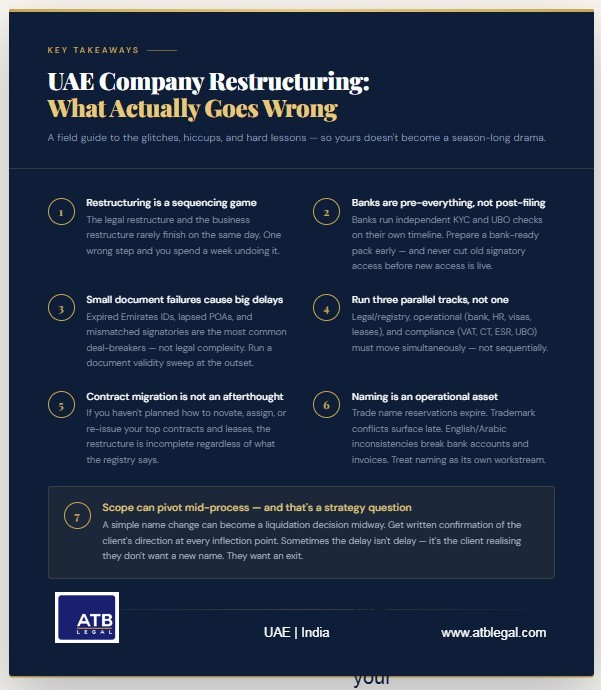
A practical field guide to what actually goes wrong—so your restructuring doesn’t turn into a season-long drama.
Disclaimer: This article is for general information only and does not constitute legal or tax advice. Dates and amounts mentioned are for illustrative purposes. Rules and practice can vary by emirate and by licensing authority; specific advice depends on your facts and structure.
Why Restructuring feels Smooth… Right Up Until It Isn’t
On paper, restructuring is elegant: tidy board resolutions, clean cap tables, a crisp “before vs after” organization chart, and a timeline that looks like it was made by someone who has never met a bank compliance team.
In real life, UAE restructuring sits at the intersection of:
- Corporate registries and licensing authorities (mainland and free zones),
- Notarization/attestation norms, and
- Operational dependencies (banks, visas, leases, VAT, Corporate Tax, ESR/UBO, vendor contracts).
And the reality is: the “legal restructure” and the “business restructure” rarely finish on the same day.
The Classic Restructuring ‘Plot Twists’ and What They Usually Mean
“Everything is ready—just one small signature.”
What it looks like: The group is aligned, documents are drafted, and then someone says:
“We just need the right signatory on the right resolution in the right format.”
Root causes (common in UAE restructures):
- Signatory authority doesn’t match what’s on the trade licence / registry file.
- Board/Shareholder resolution format doesn’t match the authority’s expectations.
- POAs are missing, expired, or not acceptable without proper notarization/attestation.
- Different entities in the group follow different governance rules (mainland vs free zones including DIFC/ADGM).
Practical fix:
- Do a signatory audit before you draft the final pack: who signs what, under which authority, and with what proof?
- Standardise a “signing matrix”: document type → signer → capacity → supporting evidence.
“The Registry Accepted it… Why is the Bank Refusing?”
What it looks like: Licence amended, name changed, shareholding updated. Bank still says “No updates possible” or temporarily freezes activity.
Root causes:
- Banks need their own KYC refresh (often deeper than registry requirements).
- Mismatch between:
- registry shareholder records,
- UBO declarations,
- and bank’s internal UBO/controlling person assessment.
- Changes trigger enhanced due diligence (EDD) if there’s a new shareholder, new jurisdiction, new activity, or new flow of funds.
Practical fix:
- Treat the bank as a parallel regulator with its own timeline.
- Prepare a bank-ready pack early: updated corporate docs + old/new structure chart + source of funds/source of wealth narrative + authorised signatories + key contracts (where relevant).
- Plan for “continuity”: don’t kill old signatory access before new access is live (when possible).
“The Excel cap table is perfect; the authorities disagree.”
What it looks like: Share transfers seem simple until you encounter:
- minimum shareholding rules (where applicable),
- class of shares issues,
- paid-up capital proofs,
- pre-emption/approvals,
- or valuation/tax documentation requirements.
Root causes:
- The legal reality is governed by the commercial companies regime and the specific authority’s rules (and sometimes their unwritten preferences). UAE merger mechanics and approvals are treated as formal corporate actions, not just internal bookkeeping. (UAE Legislation)
- In ADGM, for example, capital reduction is a structured process with specific steps in the rulebook. (en.adgm.thomsonreuters.com)
Practical fix:
- Confirm early if the restructure is:
- share sale/transfer,
- asset transfer,
- merger/amalgamation,
- conversion of legal form,
- hive-up/hive-down,
- or a group internal reorganisation.
- Don’t rely on “templates from another jurisdiction”—UAE authorities can be precise about format and sequencing.
“Naming: the easiest thing… became the longest thing.”
What it looks like: Trade name reserved. Everyone celebrates. Then:
- name conflicts in another emirate/free zone,
- trademark clashes,
- translations don’t align,
- or the bank/account name formatting breaks (yes, really).
Root causes:
- Trade name rules are not uniform across all authorities.
- English/Arabic naming consistency becomes operationally critical (banks, invoices, customs, contracts).
Practical fix:
- Treat naming as a project track, not a footnote:
- reserve early,
- check brand/trademark risk,
- and lock the English/Arabic format consistently across documents.
“We Restructured the Company… But the Visas Didn’t Get the Memo.”
What it looks like:
New entity exists. People still sit on old visas. Labour files don’t align. Immigration portals show the old sponsor details.
Root causes:
- Immigration/labour processes are operationally separate.
- Employee sponsorship transfers, establishment cards, quota, and HR files have their own sequencing.
Practical fix:
- Run HR/immigration as a dedicated workstream:
- what moves (people),
- what stays (contracts),
- what must be re-issued (permits/cards),
- and when.
VAT/Corporate Tax/ESR/UBO: The Compliance Hydra
What it looks like:
You change structure and suddenly you’re answering questions like:
- Does the VAT TRN need updating?
- Do we need group VAT changes?
- What about Corporate Tax registration/reporting?
- Does ESR apply to the new entity/activity?
- Do UBO filings need refresh?
Root causes:
- Restructuring often changes:
- economic substance profile,
- control/beneficial ownership,
- business activity classification,
- and reporting responsibilities.
Practical fix:
- Maintain a compliance change log: every structural change → what it triggers (VAT/CT/ESR/UBO/licensing/bank/HR/customs).
- Don’t wait for the “final step” to start updates—many updates require lead time and supporting docs.
Contracts: The Silent Saboteur
What it looks like:
Everything is legally “new,” but vendors/customers still pay the old entity, the old entity still bills, and the lease is in the wrong name.
Root causes:
- Contracts may require:
- consent,
- novation,
- re-issuance,
- or at least formal notice.
- Counterparties move slowly (and sometimes opportunistically).
Practical fix:
- Create a contract migration list:
- top 20 revenue contracts,
- top 20 cost contracts,
- leases,
- key supplier/distributor agreements,
- IP licences,
- financing/security docs.
- Decide per contract: assignment vs novation vs fresh contract.
The Hiccup Library: Quick Symptoms, Likely Causes and Remedies
“Portal rejected our application”
- Likely cause: mismatch in activity codes, document format, or signing capacity.
- Remedy: use authority-specific document formats; confirm signatory powers; keep consistent Arabic/English names.
“Attestation ate our timeline”
- Likely cause: overseas documents not legalised/attested in the correct chain.
- Remedy: start attestation early; use scanned drafts only for drafting, not filing.
“Shareholder is abroad, and everything stalled”
- Likely cause: notarisation requirements, in-person signing, or POA constraints.
- Remedy: build a POA route early, or plan for signing windows.
“We discovered a ‘hidden’ shareholder arrangement mid-way”
- Likely cause: side letters, nominee arrangements, informal investor understandings.
- Remedy: flush these out at the start—banks and UBO filings dislike surprises.
“Merger/reorg triggered additional regulatory questions”
- Likely cause: the transaction qualifies as an “economic concentration” / merger-control type filing depending on thresholds and structure. (White & Case)
- Remedy: screen early for competition/merger-control triggers as part of legal due diligence.
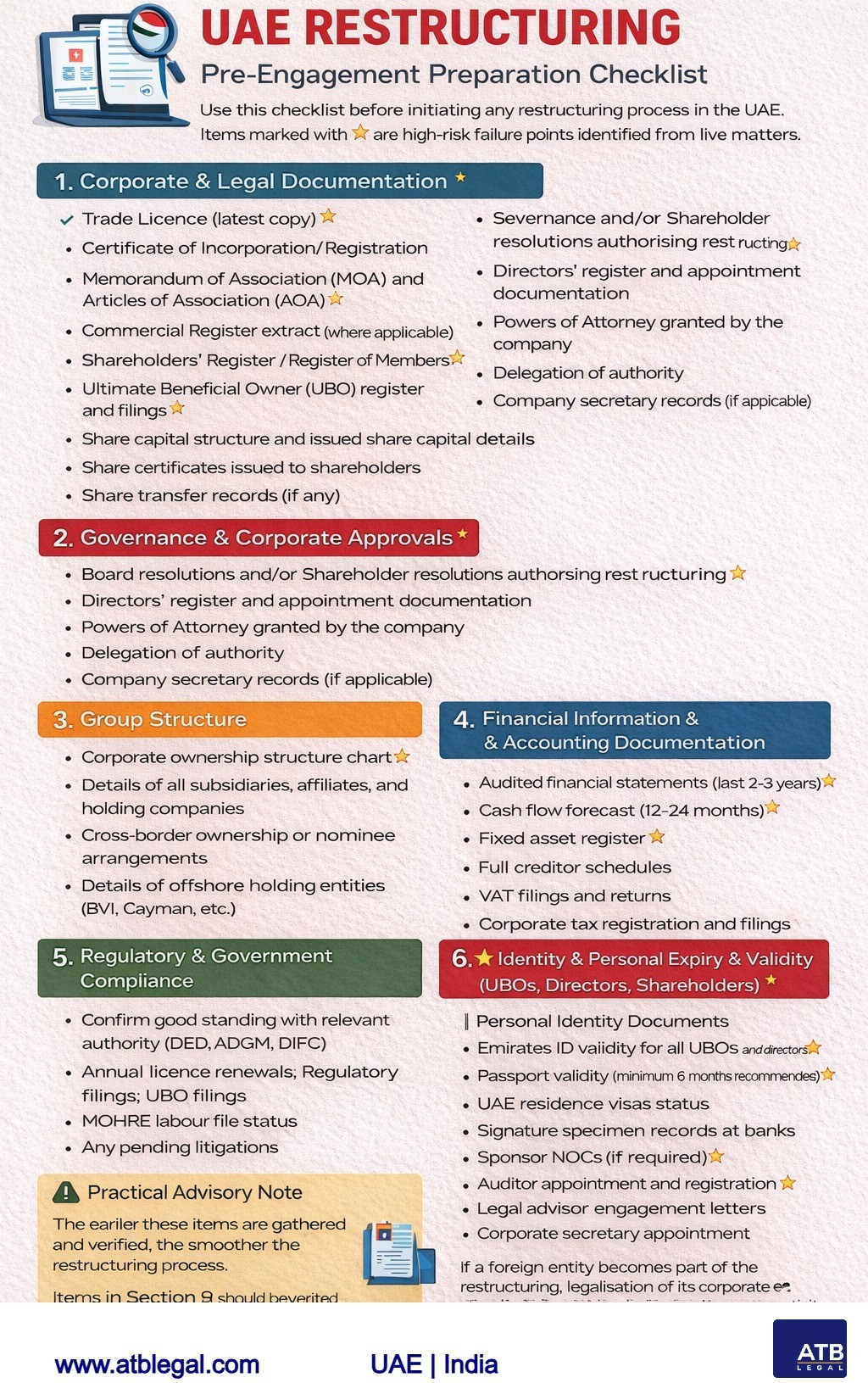
A Practical “Pre-flight Checklist” That Prevents 80% of the Pain
Run three parallel checklists (not one)
- Legal/registry track: approvals, filings, resolutions, constitutional docs
- Operational track: bank, HR/visas, leases, customs, insurance
- Compliance track: VAT, Corporate Tax, ESR, UBO, audits, economic registers
Build the “one pack to rule them all”
A single master folder with:
- old + new structure charts,
- old + new corporate documents,
- signing matrix,
- board/shareholder resolutions,
- UBO details,
- key contracts list,
- and the step-by-step timeline.
Accept the truth: timelines depend on your slowest stakeholder
The authority may be fast. Your counterparty may not be. Your bank may have a committee that meets “when the stars align.”
War-story Lessons (The Hard Ones)
- Restructuring is a sequencing game. Do the wrong step first, and you’ll spend a week undoing it.
- Banks are not “post-filing.” Banks are “pre-everything.”
- Names and signatories are operational assets. Treat them that way.
- If you didn’t plan contract migration, you didn’t plan restructuring.
- Compliance doesn’t “follow later” unless you want penalties and blocked processes. (ADGM explicitly frames event-driven filings as obligations, with potential fines for non-compliance. (ADGM))
Closing thought: A Restructure Doesn’t Fail Because of one big issue. It usually wobbles because of ten small issues that arrive on different days, each saying, “Hi, I’m just a minor formality.”
So yes—expect glitches. Expect hiccups. Expect at least one moment where Excel looks innocent and reality looks personal.
But with a proper signing matrix, a bank-first strategy, a contract migration plan, and parallel compliance tracking—you can keep the chaos entertaining… rather than expensive.
So much for the generic perspectives. Here we share a couple of real-life experiences we went through in recent times.
War Story #1: The Trade Name Timer vs. The ID Renewal Black Hole (Abu Dhabi | Acquisition + Name Change)
The setup:
A European buyer engaged us for an acquisition of an Abu Dhabi mainland company, where a trade name change was one step within the broader deal timeline.
The “perfect plan” (on paper):
- The amended MOA draft was shared with the client on 24 September 2025.
- The trade name reservation application was filed on 26 September 2025.
The glitch:
The trade name reservation certificate was valid only for a limited period, and it expired on 25 October 2025. Meanwhile, we were waiting for the renewed Emirates ID copies of two key individuals (for signing/notary/authority purposes). The renewals remained pending — and the trade name clock did what trade name clocks do: it didn’t wait.
What this caused (the practical pain points):
- Once the reservation expired, the trade name reservation had to be re-applied, which effectively reset part of the process.
- The MOA notarisation could not be progressed without valid and updated identity documents.
- A downstream step such as newspaper publication (where required depending on authority/notary requirements for amendments) was also pushed out.
- Final issuance of the updated trade licence was delayed—not because the restructure was conceptually difficult, but because the pipeline depends on one small document being current at the right time.
Action path (what we do next):
- Once renewed Emirates IDs are provided, re-submit the trade name reservation application to the Abu Dhabi licensing authority.
- Finalise and notarise the amended MOA based on the reserved name and updated details.
- Complete newspaper publication if required by the authority/notary for amendments.
- Submit notarised documents → proceed for final payment → obtain the renewed trade licence reflecting the updated trade name.
Hard lesson (with a grin):
In UAE restructuring, the trade name timer is ruthless — and Emirates ID renewals don’t care about your timer.
War Story #2: Name Change Today… Liquidation Tomorrow (Dubai | Trade Name Change + Scope Creep + Strategy Pivot)
The setup:
A Dubai mainland company approached us for a trade name change. The process started smoothly — then took a few sharp turns.
The “good progress” phase:
- A follow-up receipt was issued on 10 September 2025.
- An external approval (for example, a municipality-related approval depending on the activity/location) was obtained on 16 September 2025.
- The MOA draft was shared on 24 September 2025.
The glitches (plural):
- After reviewing the MOA, the client informed us that the name must be revised again to a specific format (e.g., “ABC xyz LLC”).
- The client also requested Ejari renewal as an additional scope item.
- We sought confirmation to proceed (revised name + Ejari scope), and then… silence.
The plot twist:
On 30 October 2025, during an in-person meeting at the client’s office, we were verbally informed that management was considering winding up / liquidation instead of continuing with the name change.
Why this matters (the practical lesson)
This is more common than clients realise: a “simple” trade name change can become a strategy decision midway — especially if the business is rethinking operations, ownership, costs, or viability. The legal process doesn’t just pause; it can become a different project entirely.
Action path (what we do next)
Obtain written confirmation of the route forward:
- proceed with trade name change, or
- shift to liquidation, or
- explore restructuring options (if the objective is reorganisation rather than closure).
If liquidation is confirmed (example figures, liable to change with time and regulations):
- Authority/government costs: ~AED 4,000 + VAT
- Professional fees: ~AED 10,000 + VAT
- Note: This does not include the liquidator’s charges and applicable fines if any which are payable at actuals.
If restructuring is chosen instead, we re-scope based on the method (amendments/transfers/conversion/group reorganisation) and remap the compliance/operational checklist accordingly.
Hard lesson (with a grin): Sometimes the “delay” isn’t delay — it’s the client’s sudden realisation that they don’t want a new name… they want an exit.